


Clinical Characteristics
Ocular Features
Tiny lens opacities of blue or white color generally appear from birth through 18 and 24 months of age but may not be diagnosed until adulthood. They first appear at the outer edge of the fetal lens nucleus or in more superficial cortical layers depending on the type. Infants may be visually impaired from birth and develop nystagmus and amblyopia. The opacities are usually bilateral and progressive. Lens removal may be required in early infancy but often not until the 2nd to 4th decades.
Systemic Features
No systemic abnormalities are associated with cerulean cataracts.
Genetics
Inheritance
Lens opacities can, of course, be associated with chromosomal aberrations, developmental conditions, intrauterine infections, and metabolic errors as well as single gene mutations. About 23% are familial but even among these there is considerable genetic and clinical heterogeneity that confounds the nosology despite notable recent progress in genotyping. Due to clinical heterogeneity, it is not always possible to classify specific families based on the appearance and natural history of the lens opacities alone.
Cerulean cataracts of congenital or childhood onset can be due to mutations in genes that encode various lens crystallins. Type 1 (CCA1; 115660) or ‘blue dot’ cerulean cataracts result from mutations in a gene located at 17q24 but its identity is as yet unknown. Intriguingly, it is located in the same chromosomal vicinity as the galactokinase deficiency gene (GALK1). The lens opacities follow an autosomal dominant pattern of transmission. The mutation, however, does not appear to involve a gene that codes for any of the major structural proteins of the lens.
Type 2 (CCA2; 601547) results from mutations in the CRYBB2 gene (22q11.2-q12.2) encoding the beta-B2-crystallin protein. Inheritance is autosomal dominant.
Type 3 (CCA3; 608983) is caused by mutations in CRYGD (2q33-q35) coding gamma-D-crystallin. It has been reported in a single family in which it seemed to appear earlier and progress more rapidly than other types. The pedigree pattern was consistent with autosomal dominant inheritance. Mutations in the same gene also cause an allelic disorder designated nonnuclear polymorphic congenital cataracts or PCC (601286), which may simply be clinical heterogeneity of the same condition.
Type 4 (CCA4; 610202) is due to mutations in the MAF gene (16q22-q23) and is also inherited in an autosomal dominant pattern. Lens opacities have a later, more juvenile onset and the lens opacities are located in a lamellar distribution in superficial cortical layers. These are progressive and often result in posterior subcapsular opacification that requires lens extraction in adults.
Type 5 (CCA5; 614422) is the result of a mutation in a locus at 12q24 and is dominantly inherited. The opacities are located throughout the lens but are most numerous in the cortex. They are most commonly diagnosed in the second decade of life and lens extractions are required a decade or so later.
Other forms of autosomal dominantly inherited, congenital, progressive lens opacities include Volkmann type (115665), Coppock-like (604307), lamellar (116800), and congenital posterior polar (116600) cataracts.
Pedigree
Autosomal dominant
Autosomal dominant disorders require only one mutation for the disease to be expressed. Since an affected parent has two chromosomes, only one of which has the mutant gene, parents can expect that half (50%) of their children will receive that one and inherit the disease. It is common for individuals that inherit the mutation, however, to not have evidence of the disease (nonpenetrance).
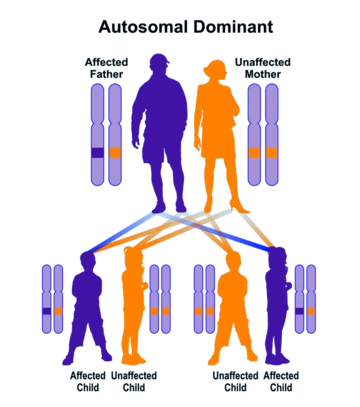
Autosomal dominant inheritance leads to a vertical pattern of transmission